Time and again throughout the war came the tale of masts split open and tumbled into the sea. The explanation was that since Cromwell's time the navy had depended on New Hampshire and Maine for its great masts; the colonists had cut off the supply at the opening of the war; and Sandwich neglected to seek substitutes elsewhere. When France entered the war, she dispatched a fleet to America. Admiral Byron, the poet's grandfather, was sent with thirteen ships to head them off. A mild gale struck his squadron in mid-Atlantic, the rotten masts broke, the ships limped away in every direction, and only one reached New York ahead of the French. So it went throughout the war.
(from A History of England and the British Empire)
Monday, June 25, 2018

Sunday, June 24, 2018
But he did invent the sandwich!
It is hard to say whether Lord Sandwich, in charge of the navy, or Lore George Germain, in charge of military affairs, did more damage to the British cause. Sandwich, a cynical debauchee, termed one of the most dissolute men of Georgian England, won immortality of a sort of having meat placed between slices of bread so that he could lunch without having the leave the table and break his luck while gambling. By neglecting the material condition of the ships and by alienating the Whig admirals, Sandwich probably did more damage to the navy entrusted to his care than any hostile French admiral had ever done.
(from A History of England and the British Empire)
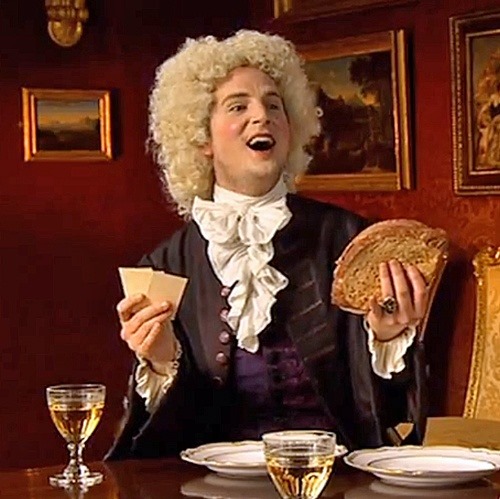
(from A History of England and the British Empire)
Saturday, June 23, 2018
They wanted the war
It is difficult to say at what time the American Revolution became inevitable; but it is likely that a successful compromise might have been achieved if it had not been for two men: George III in England and Samuel Adams in Boston. The king was to display several times that the colonial defiance should not go unpunished, though many Englishmen were ready to smooth things over. So, too, were many Americans; but Samuel Adams, by continual inflammatory correspondence, strove to keep alive the original indignation engendered by the Stamp Act.
(from A History of England and the British Empire)
(from A History of England and the British Empire)
Friday, June 22, 2018
Just ship him out!
Capt. Shafer: Miss Hale, didn't you tell me that we had a request for a dentist at our Greenland base?
Miss Hale: No, sir. I think you made that up, sir.
Capt. Shafer: You're right, I did. Now, I want you to cut orders assigning Dr. Blair overseas.
Miss Hale: Where overseas, Sir?
Capt. Shafer: Pick someplace! Wait a minute! . . . Guam! Yes, that would be a good place for our millionaire playboy to spend the winter, don't you think so, Doctor?
(from the Hennessey TV program)
Interestingly, I once worked for a man who had been stationed on Guam, and from what he said, that would be exactly the place to take the wind out of the sails of a high-life sort.
Miss Hale: No, sir. I think you made that up, sir.
Capt. Shafer: You're right, I did. Now, I want you to cut orders assigning Dr. Blair overseas.
Miss Hale: Where overseas, Sir?
Capt. Shafer: Pick someplace! Wait a minute! . . . Guam! Yes, that would be a good place for our millionaire playboy to spend the winter, don't you think so, Doctor?
(from the Hennessey TV program)
Interestingly, I once worked for a man who had been stationed on Guam, and from what he said, that would be exactly the place to take the wind out of the sails of a high-life sort.
The Black Hole of Calcutta
The Bengal prince was annoyed at the defenses which the British began to make at Calcutta as soon as they learned of the outbreak of the Seven Years' War. He swooped down on the city, captured it, and herded one hundred and forty-five Englishmen and the half-caste wife of one of them into a little room, the "Black Hole," barely eighteen feet long and fourteen feet wide. All day and all night the suffocating group called in vain for more air and for water. On the following morning only twenty-three still remained alive; among these the woman, who was taken to Surajah Dowlah's harem.
(from A History of England and the British Empire)
(from A History of England and the British Empire)
Thursday, June 21, 2018
The ideal wife
"Now there's a woman that's got everything a man could ask for: enough muscles to pull a plow and not enough brains to start an argument." (Grandpa McCoy)
Leo the Lion
What is the name of the MGM lion? There actually have been seven of them through the years, and all of them have been called "Leo," although that is the actual name only of the current holder. In order, they have been:
Slats (1916-1928)
Jackie (1928-1956)
Telly (1928-1932)
Coffee (1932-1935)
Tanner (1934-1956)
George (1956-1958)
Leo (1957-present)
Jackie appeared in over a hundred movies, in addition to his logo work, including the Johnny Weismuller "Tarjan" films

Slats (1916-1928)
Jackie (1928-1956)
Telly (1928-1932)
Coffee (1932-1935)
Tanner (1934-1956)
George (1956-1958)
Leo (1957-present)
Jackie appeared in over a hundred movies, in addition to his logo work, including the Johnny Weismuller "Tarjan" films
Wednesday, June 20, 2018
Not an impressive peer
Newcastle was a master politician, but a ridiculous statesman. A fussy little man, who enjoyed power for its own sake, he bustled around with an air of great importance. One wit remarked that Newcastle always "lost half an hour in the morning and spent the rest of the day running after it."
(from A History of England and the British Empire)
(from A History of England and the British Empire)
Tuesday, June 19, 2018
Unwieldy name for a Lady
She is Lady Stuart, the wife of the 2nd Viscount Stuart of Findhorn. Her birth name was Grizel Mary Wilfreda Fyfe. Sort of an awkward name for a blueblood, one would think, wouldn't one?

Heroic, but futile
The high point came in 1745 at Fontenoy, on the Scheldt. Cumberland attacked a position strongly fortified by Saxe. The British infantry made one of the most remarkable attacks in its history. Forming under heavy artillery fire, the thin red line marched slowly in perfect order for half a mile, constantly closing up the gaps torn in the ranks. Not firing a shot, the redcoats advanced until within fifty yards of the enemy. A French commander, according to legend, stepped out in front of his line, bowed low, and requested the English gentlemen to fire first, an English officer responded to this courtesy by proposing a toast to the gallant foe. Then the British fired, and several crack regiments of the French army simply melted away under their crushing volleys. But the attack was in vain, for the Dutch and Austrian allies had not cleared away their sections of the French line, and the British had to retire.
(from A History of England and the British Empire)
(from A History of England and the British Empire)
Monday, June 18, 2018
One main result from this war
By 1742, the "War of Jenkins' Ear" had died of inertia, becoming involved in a more general European conflict. England's only worthwhile gain from this effort to loot the Spanish empire was Anson's demonstration that lime juice is an excellent preventative for scurvy, a disease prevalent among sailors deprived of vitamin-bearing fresh foods on long voyages.
(from A History of England and the British Empire)
(from A History of England and the British Empire)
Sunday, June 17, 2018
The old queen is doing them a favor
Queen Elizabeth is popular in England. Prince Charles, next in line for the throne, is not. Prince William, his son with the three cute little children, is very popular.
Queen Bess is doing them a favor by hanging in there. Every year that she lives is a year less that Charles will reign, and a year closer to the coronation of William.

Queen Bess is doing them a favor by hanging in there. Every year that she lives is a year less that Charles will reign, and a year closer to the coronation of William.
Saturday, June 16, 2018
Cabin fever
"Scott Collins was restless and irritable, but he fought down the feeling, knowing that there was nothing worse in the confinement of a snowbound shelter than a man who grumbles and complains." (from Down the Long Hills, by Louis L'Amour)
The more confined the circumstances, the more essential courtesy becomes. Thus the contrast between the lack of restraint in the western USA and the exquisite courtesy of Japan.
The more confined the circumstances, the more essential courtesy becomes. Thus the contrast between the lack of restraint in the western USA and the exquisite courtesy of Japan.
Friday, June 15, 2018
Learning to see
From hearing the mountain man talk, he had learned something about looking and seeing. All people look, but few really see; and they can rarely give details of any place they have passed - its appearance or what might be found there.
(from Down the Long Hills, by Louis L'Amour)
Thursday, June 14, 2018
Women? Argue? Perish the thought!
One thing you could say for Betty Sue. She would do what she was told, without making a big argument. A sight better than most grown-up women . . . always arguing a man. Even Mrs. Andy. She couldn't do anything without making a lot of talk about it. Fussed more than a jaybird over a garden snake.
(from Down the Long Hills, by Louis L'Amour)
(from Down the Long Hills, by Louis L'Amour)
Tuesday, June 12, 2018
A word that just does not fit
Doughty means "brave and persistent." Well and good, but it just does not sound like it. Some words sound like they ought to mean what they do. For example, "curmudgeon" sounds like a gripey old man, which is what it indicates. But "doughty" looks like it ought to have something to do with the Pillsbury Dough Boy.
Monday, June 11, 2018
An old story
Man for man, the Redcoats [of the 1700s] were as good as any soldiers in Europe. Too often it was a case of "heroes led by fools" or "lions led by asses;" for in battles like Bunker Hill the men executed, with utmost bravery, stupid orders which should never have been given.
(from A History of England and the British Empire)
(from A History of England and the British Empire)
Sunday, June 10, 2018
Press gangs
To man the fleets, the same Parliament which talked so much of the "fundamental rights of Englishmen" and the "sanctity of private property time and again authorized impressment, which was virtual kidnapping. Sailors in the merchant marine, looking forward to shore leave after a long voyage, would often find themselves taken off for naval service before they reached land. The men of the coast towns were always on guard against the press gangs which made sailors, willy-nilly, out of anyone upon whom they could lay their hands. Once caught in this way, the poor devils often had to remain in naval service until disability released them.
(from A History of England and the British Empire)
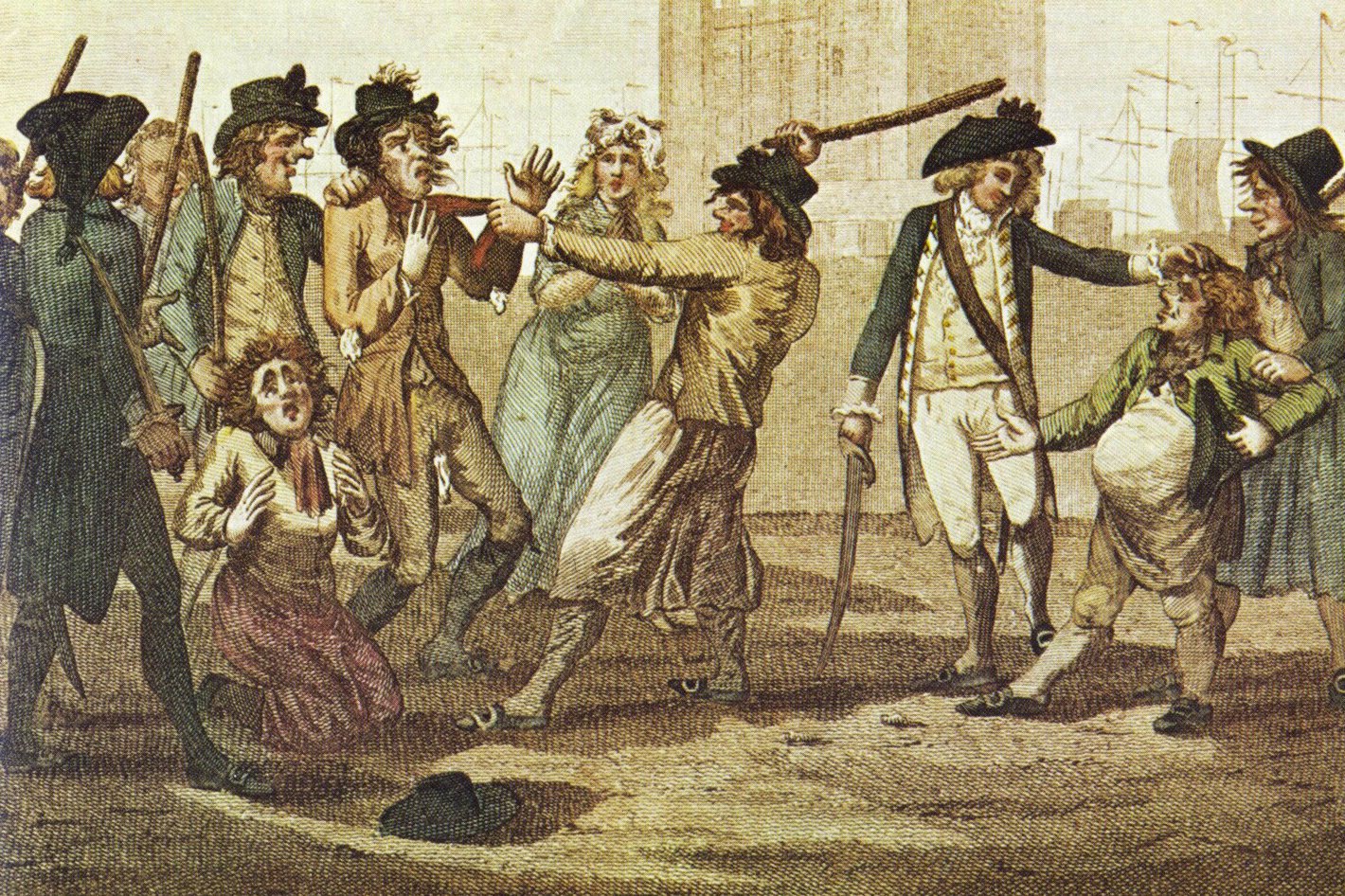
(from A History of England and the British Empire)
Saturday, June 09, 2018
They couldn't cut it on their previous engagement
Fred Allen said that Rodney Smythe Beddington and his Gut-Bucket Gondoliers wanted to get on with him because at their previous gig the audience had thrown wet tea bags into the French horns.
Friday, June 08, 2018
The problems with shipbuilding
[Ships of the line during the 1700s] required for the hull some two thousand oak trees, averaging a hundred years old, and England was cutting down her oaks much faster than she was replacing them. There was particular difficulty in securing great trees for the massive sternposts, and crooked timbers for the sixty or seventy ribs of the ship. For the planking of the bulging yellow sides England had to send to Danzig, Riga, or other ports of the Baltic, whence also, from Polish forests, came the masts of middling size. The little spars had general grown on some Norwegian mountainside; but for the great lower masts, anywhere from two feet to forty inches in diameter, the royal navy depended upon colonial pines in New Hampshire and Maine. More than once, as we shall see, the navy was to be handicapped when its supply of masts or oak was curtailed.
(from A History of England and the British Empire)
(from A History of England and the British Empire)
Thursday, June 07, 2018
Anthony Caruso: not what he seemed
He had the name and the face for it: Anthony Caruso, with a cleft chin and chiseled features that looked exactly like what he was - the son of Italian immigrants. After he made his film debut in 1940, he had a variety of roles, with a good number of them being gangsters and heavies.
However, in real life Caruso was far from a "heavy." He was happily married for 63 years, and he was described as "the consummate family man" who was very fond of gardening and cooking. The Carusos were a "tongue-twister family: Tony and Tonia were the parents of Tonio and Tina.
However, in real life Caruso was far from a "heavy." He was happily married for 63 years, and he was described as "the consummate family man" who was very fond of gardening and cooking. The Carusos were a "tongue-twister family: Tony and Tonia were the parents of Tonio and Tina.
Wednesday, June 06, 2018
The British navy
England's chief pride and interest, of course, lay in her navy. The royal navy has probably enjoyed a longer record of power and success than any other fighting organization in history except the Roman army. England maintained it on a two-power basis, ordinarily keeping it as large as the combined forces of the French and Spanish Bourbons, who might always be expected to join forces. It consisted during the eighteenth century of three or four hundred vessels, about a hundred of which belonged to the important category known as ships-of-the-line or line-of-battle ships Counterparts of our modern battleships, they were used in squadrons or fleets to fight the major battles.
(from A History of England and the British Empire)
(from A History of England and the British Empire)
Tuesday, June 05, 2018
Nice work, if you can get it
Best of all were the official appointments, where drawing a salary was frequently the only work involved. Some of these, like the post of Master of the King's Buckhounds, were absolute sinecures in which no work was expected. More frequent was the practice of accepting a well-paid position and then appointing a deputy who did all the work for a small fraction of the salary. One George Selwyn, who controlled two or three votes in the Commons, was "at one and the same tie, Surveyor-General of Crown Lands, which he ever surveyed; Registrar of Chancery at Barbados, which he never visited; and Surveyor of Meltings and Clerk of the Irons at the Mint, where he showed himself once a week in order to eat a dinner which he ordered but for which the nation paid."
(from A History of England and the British Empire)
(from A History of England and the British Empire)
Monday, June 04, 2018
Verna Felton - another of those familiar faces
She played lots of parts, and folks always knew her face, but hardly anyone outside Hollywood knew her name. Verna Felton was one of the stock grumpy old women.

Sunday, June 03, 2018
Scottish highlanders in the early 1700s
Beyond the Highland line was another Scotland, wilder, less civilized, and even poorer. The clansmen of the Highlands cared little for the authority of Kirk or king; to them the paternalistic chief, with his power of life and death, was everything. They preserved more of their Celtic inheritance than that, in their speech, in their romantic belief in the supernatural, and in many other ways, while in religion a large section of them were still Roman Catholic. No Sir Walter Scott had yet appeared to give to Lowlanders and Englishmen a glamorous picture of this Highland life; to the outsiders the kilted clansmen in their plaids were dangerous relics of an older and lower civilization. Physical danger and the utter absence of roads in those wild hills discouraged most southerners from venturing beyond the line.
(from A History of England and the British Empire)
(from A History of England and the British Empire)
Saturday, June 02, 2018
Freeze them into submission
By 1709, France was bled white and ready for peace. On top of her defeats and an empty treasury from such prolonged warfare, she was faced with famine after an especially bitter winter, the "Great Frost," which froze crops in the ground and peasants in their huts.
(from A History of England and the British Empire)
(from A History of England and the British Empire)
Friday, June 01, 2018
Pete and Gladys
This is an old television sitcom that starred Harry Morgan and Cara Williams. It involved the typical familial situations, usually brought on by Gladys' lack of common sense or overreaching confidence. Williams was one of the prettier of the female comediennes, with large, expressive eyes. It was an entertaining program. Some of the episodes are currently available on YouTube.

Thursday, May 31, 2018
The genius of John Churchill (Duke of Marlborough)
John Churchill was perhaps the greatest military genius who ever fought for England, and certainly the best general since Cromwell's day. Far superior to William III as a general, he was fully his equal in keeping together ill-assorted and jealous allies. In a day of generally static methods of warfare, with siegecraft predominating, Marlborough injected a boldness and originality into strategy, and on the battlefield his keen mind and quick eye seemed always to pick out the best tactical movements. It was not only as a strategist and battle tactician that he excelled. If genius is "the capacity for taking infinite pains," he qualified for that highest distinction. No small part of his success came from his meticulous foresight for every detail: his soldiers always had food, clothing, shelter, and pay, and came to the battlefield in the pink of condition.
(from A History of England and the British Empire)
(from A History of England and the British Empire)
Wednesday, May 30, 2018
Close votes in Parliament
It was nip and tuck [between the Tories and the Whigs] during this reign and the next one. No one could foresee with surety how an election would result, nor was there even any certainty as to the outcome of a vote in the closely balanced House of Commons. The absence of a few Whigs or Tories for a cockfight or a party might be enough to change the vote.
(from A History of England and the British Empire)
(from A History of England and the British Empire)
Tuesday, May 29, 2018
Elfego Baca
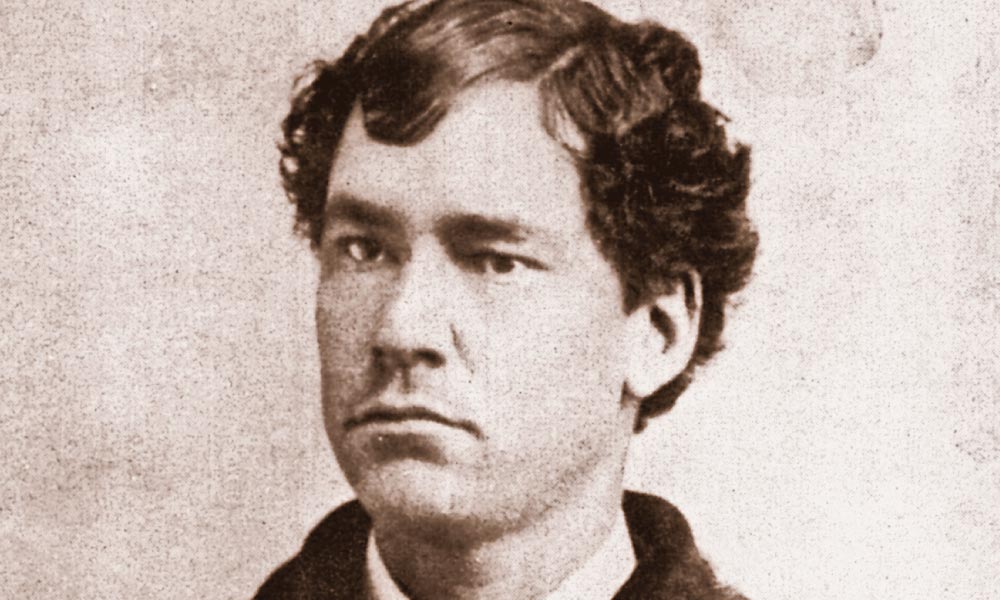
Walt Disney produced a mini-series for television about Elfego Baca, who was a real-life figure - a lawman and politician. There is one remarkable episode depicted in the TV program that evidently was true, although almost unbelievable. Between 40 and 80 gunmen shot it out with Baca, alone in an adobe hut, firing somewhere close to 4000 shots, and yet he emerged unhurt. The door was introduced as evidence in Baca's trial (he was acquitted) with more then 400 bullet holes in it. Although not exemplary in much of his life, Baca's courage was without question.
Monday, May 28, 2018
Designations on the political spectrum
Then [1661] and ever since, men have tended to fall into four different general attitudes toward political policy: reactionary, conservative, liberal, radical. It is well to distinguish carefully among those terms; for they keep recurring and are often misapplied. The reactionary is one who wishes to go back to former conditions; the conservative, usually well contented with things as they exist, is psychologically or economically opposed to any considerable change; the liberal has a broadminded attitude, ready to preserve whatever seems to him good in the old, but equally ready to make changes which seem to him improvements; while the radical, as the Latin derivation indicates, desires to get at the roots and start anew.
(from A History of England and the British Empire)
(from A History of England and the British Empire)
Sunday, May 27, 2018
Shared rulers: a very strange situation, at least to us today
In the grave crisis of invasion Amsterdam brought to the head of government a slender, taciturn young man of twenty-two, the third William of Orange to govern Holland. Sixteen years later he was also to be the third William to rule England.
(from A History of England and the British Empire)
(from A History of England and the British Empire)
Saturday, May 26, 2018
Understandable stage name
Lisa Montell was an actress from the 1950s and 1960s, who usually played Latino or Mediterranean roles because of her dark complexion. Her birth name was Irena Ludmilla Vladimirovna Augustinovich, so it is easy to see why she adopted a stage name.
Friday, May 25, 2018
The lot of the Royal Navy in the 1660s
Rotten ships and ill-fed, unpaid crews too often hampered the efficiency of naval operations. The later remarkable breed of professional navy officers had not yet developed. Some were courtier captains, who could barely keep their feet planted on deck in a moderate sea; others were crude, unlettered, but effective "tarpaulins," who had risen from the forecastle. As Macaulay remarked, "There were gentlemen and there were seamen in the navy of Charles the Second. But the seamen were not gentlemen; and the gentlemen were not seamen."
(from A History of England and the British Empire)
(from A History of England and the British Empire)
Thursday, May 24, 2018
A rough couple of years in London
Shortly after Charles came to the throne, London encountered two calamities in rapid succession: the Plague in 1665 and the Great Fire in 1666. The Plague was the last violent outbreak of the same scourge which had cropped out from time to time since the Black Death three centuries earlier. This time its effects were limited pretty much to London, where at least seventy thousand are estimated to have died in a few months The sturdy Pepys was among the few who stayed at his work while other fled - "little noise heard night or day," he wrote, "but the tolling of bells." . . .
The following year (1666) London was struck again, this time by a fire which raged five days and cleared out a considerable part of the City. It spared the slums to the eastward, not did it extend far toward Westminster; but in the City proper it destroyed some thirteen thousand homes and eighty-nine churches
(from A History of England and the British Empire)
The following year (1666) London was struck again, this time by a fire which raged five days and cleared out a considerable part of the City. It spared the slums to the eastward, not did it extend far toward Westminster; but in the City proper it destroyed some thirteen thousand homes and eighty-nine churches
(from A History of England and the British Empire)
Wednesday, May 23, 2018
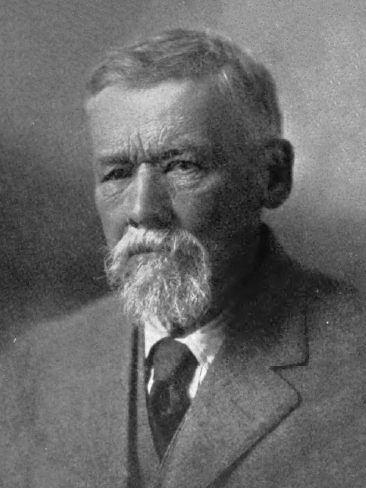
Texas John Slaughter
John Horton Slaughter was a real-life character who was depicted in a television mini-series by Walt Disney. The program is interesting and very watchable, especially if we keep in mind that the person being depicted actually did exist. Slaughter was a notable lawman and was involved in a couple of high-profile arrests involving Geronimo and the Jack Taylor Gang.
Tuesday, May 22, 2018
A dubious recommendation
In [Paradise Lost] are to be found the best qualities of Puritanism: constant courage, if not mercy; quiet confidence, if not humor; unshaken will, even if gloomy; and a spiritual exaltation, mysterious, overwhelming, which sometimes approaches the sublime.
(from A History of England and the British Empire)
(from A History of England and the British Empire)
Monday, May 21, 2018
The paradox that was Cromwell
Tragically enough, Cromwell's way ended for the time being the very constitutional ideas of government for which he had fought. The force of circumstances, combined with his own personal idiosyncrasies, fashioned out of this conscientious opponent of tyranny one of the most absolute rulers England has ever endured.
(from A History of England and the British Empire)
(from A History of England and the British Empire)
Sunday, May 20, 2018
Date With the Angels
This was a situation comedy that aired on television in the 1957-58 season. It is funny and enjoyable, but not the stuff that legends are made of. A young Betty White was the star, with Bill Williams as her husband. Nancy Kulp (Miss Hathaway on The Beverly HIllbillies) was one of the frequent faces on the show. It is available on YouTube and is worth watching.

Saturday, May 19, 2018
Handy fundraiser
One of the most ingenious revivals of ancient laws was the so-called "distraint of knighthood." According to an unrepealed statute of Edward, all landholders with a stipulated income were required to become knights. In the days of Edward the law had been designed to provide a properly equipped force of armed horsemen. Now, when 40-pound incomes had become far more common, it was used to mulct a very large group. Men had to pay a heavy fee if they became knights, and they were fined if they refused.
(from A History of England and the British Empire)
(from A History of England and the British Empire)
Friday, May 18, 2018
Thirteen colonies - who cares?
The West Indian Islands attracted even more settlers than all the mainland colonies together. An unsuccessful expedition to colonize Guiana settled on one of the islands, and before long Englishmen were swarming in great numbers to the Caribbean, the little island of Barbados, only twenty-one miles long and less than fifteen miles wide, having more settlers than all New England.
(from A History of England and the British Empire)
(from A History of England and the British Empire)
Thursday, May 17, 2018
A pretty fair profit margin
The profits of the East India Company showed a marked jump in the latter half of the century, when annual dividends sometimes reached 20 and even 50 per cent, though the English company could not match the dividend record of its Dutch rival, which averaged 18 per cent for two centuries.
(from A History of England and the British Empire)
(from A History of England and the British Empire)
Wednesday, May 16, 2018
Just take an X-ray
If you want to know what a wet noodle looks like, just take an X-ray of the spine of most of the Republicans in Washington today.
Just look Italian
You did not actually have to be Italian: you just had to look Italian, and you could make a lot of money in Hollywood back in the Golden Age playing gangsters and other bit parts. Swarthy skin and a heavy beard was about all it took.
Tuesday, May 15, 2018
Free people are skeptical people
With the precedent of Magna Carta in mind, they drew up a "Petition of right," which hit directly at the four main grievances - arbitrary taxation, arbitrary imprisonment, billeting, and martial law; for Parliament refused to be satisfied with a general promise of good behavior upon the part of the king.
(from A History of England and the British Empire)
NEVER trust your rulers, no matter how much you may be agreed with them politically. ALWAYS assume that they will abuse their power. A skeptical people is a free people.
(from A History of England and the British Empire)
NEVER trust your rulers, no matter how much you may be agreed with them politically. ALWAYS assume that they will abuse their power. A skeptical people is a free people.
Monday, May 14, 2018
Lord Buckingham's failure as a military stragetist
Expeditions were dispatched to Spain, to France, and to Germany - six expeditions in four years, and every one a miserable failure! Years of unpreparedness and neglect told their story. It always has taken England a considerable time to recover from the military stagnation of a long peace; for the Englishman engaged in civilian pursuits is quite unwarlike. There was no rush to arms; press gangs had to recruit by forced draft. Few communities allowed their better men to be rushed from their homes to what, in a time of unpreparedness, meant probable death by starvation or disease, if not on the battlefield. The army was composed of riffraff; the navy had been allowed to decay.
(From A History of England and the British Empire. This describes Britain in the early years of Charles I (1624-1628) when the country was under the control of George Villiers, Duke of Buckingham.)
(From A History of England and the British Empire. This describes Britain in the early years of Charles I (1624-1628) when the country was under the control of George Villiers, Duke of Buckingham.)
Sunday, May 13, 2018
Martin Kosleck: hitting back at the Nazis
If you are familiar with movies of the World War II period, then the face of Martin Kosleck is a familiar one to you. He spoke out against Hitler and the Nazis, and decided to leave Germany in 1931. He was subsequently placed on the Gestapo list of "undesirables."
Kosleck appeared in a number of films during that period, frequently portraying Nazis in a particularly uncomplimentary way. Many Germans resented being asked to play Nazis, but Kosleck viewed it as a chance to strike back against them in a small way. He played Joseph Goebbels five times.

Kosleck appeared in a number of films during that period, frequently portraying Nazis in a particularly uncomplimentary way. Many Germans resented being asked to play Nazis, but Kosleck viewed it as a chance to strike back against them in a small way. He played Joseph Goebbels five times.
Saturday, May 12, 2018
How many does this describe?
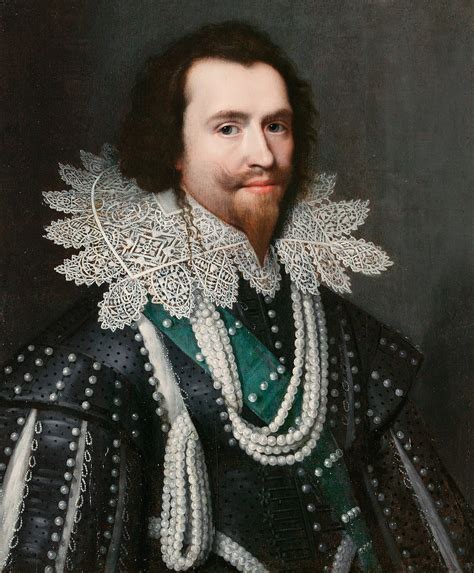
"Exceedingly charming, but one who did not leaven his ambitious ideas with common sense." This is a description of George Villiers, Duke of Buckingham in A History of England and the British Empire. I wonder how many young men throughout history that expression might have described.
Friday, May 11, 2018
King James vs. the House of Commons
The king told the Commons that they "derived all matters of privilege from him and by his grant." They replied that their "privileges and liberties are of right and due inheritance no less than our very lands and goods," and that "they cannot be withheld from us, denied, or impaired, but with apparent wrong to the whole state of the realm."
(from A History of England and the British Empire)
(from A History of England and the British Empire)
Thursday, May 10, 2018
Victor Sen Yung - a remarkable life
Victor Sen Yung made his name on the screen by playing Jimmy Chan, the son of detective Charlie Chan, in that series of movies, and also cook Hop Sing on the long-running television series Bonanza. So, his is a very familiar face to my generation.
What most of his fans probably do not know, however, are the facts that made his life fairly unique in Hollywood. He was born to Chinese immigrants. His mother died when he was about four years old in the influenza epidemic that decimated the population during the World War I years. His father traveled to China to remarry, then returned with his wife to re-establish the household.
Yung majored in animal husbandry at the University of California. He joined the Army Air Force during World War II and was involved in the production of several training films.
His role as Hop Sing was no fluke, for he was a very accomplished chef, and appeared in several cooking shows on television. He also authored The Great Wok Cookbook in 1974.
The circumstances of Yung's death were unusual. He ran a small mail-order Chinese pottery business in his home, and used an oven to cure the items. He died of a natural gas leak from the oven, and he had been dead at least ten days before his body was found. Actor Pernell Robert, who portrayed Adam on the Gunsmoke program, delivered the eulogy and paid for his funeral expenses.


What most of his fans probably do not know, however, are the facts that made his life fairly unique in Hollywood. He was born to Chinese immigrants. His mother died when he was about four years old in the influenza epidemic that decimated the population during the World War I years. His father traveled to China to remarry, then returned with his wife to re-establish the household.
Yung majored in animal husbandry at the University of California. He joined the Army Air Force during World War II and was involved in the production of several training films.
His role as Hop Sing was no fluke, for he was a very accomplished chef, and appeared in several cooking shows on television. He also authored The Great Wok Cookbook in 1974.
The circumstances of Yung's death were unusual. He ran a small mail-order Chinese pottery business in his home, and used an oven to cure the items. He died of a natural gas leak from the oven, and he had been dead at least ten days before his body was found. Actor Pernell Robert, who portrayed Adam on the Gunsmoke program, delivered the eulogy and paid for his funeral expenses.
Wednesday, May 09, 2018
Champion of the common law
The common law found a doughty champion in Sir Edward Coke, Chief Justice of Common Pleas and later of King's Bench. A thoroughly disagreeable person in public and private life, Coke was, nevertheless, remarkably well grounded in the origins of the common law, his one love in life; and he proved a tough fighter in its defense. His chief contention was that the law was superior to the king, whereas James aimed to make the judges agents of royal policy - "lions under the throne," as Francis bacon, then his attorney general expressed it.
(from A History of England and the British Empire)
(from A History of England and the British Empire)
Tuesday, May 08, 2018
The rise of representative government
The long-drawn-out conflict between parliament and the four Stuart kings, based on money and religious difficulties, was to transform England into the first modern constitutional monarchy, with the House of Commons, not the king, the real ruler. The disturbances brought about by this Parliamentary conflict were to give impetus to the planting on the Atlantic coast of North America of some of the sturdiest colonies any nation has ever owned. Ever since the Norman Conquest, England had been drawn into Continental problems and had developed, despite her insular peculiarities, on the same general pattern as the rest of western Europe. Now she was to turn in the opposite direction. In a period which has been called "the Age of Absolutism" in Continental history, a time when royal autocracy was reaching its height in the chief European countries, the English Parliament was to force the crown to submit to its domination.
(from A History of England and the British Empire)
(from A History of England and the British Empire)
Monday, May 07, 2018
Raleigh - not everyone's cup of tea
Adept at intrigue, [Sir Walter Raleigh] made a habit of criticizing his superiors to their superiors and rose rapidly. He soon won the favor of the queen, who from time to time presented him with lucrative monopolies, and sufficient estates in England and Ireland to make him the most extensive landholder in the country. Historians question the familiar story of the cloak and puddle, but it was perhaps typical or the tactics by which he became the chief favorite of Elizabeth in the middle period between Leicester and Essex. Few men of Elizabethan England were more thoroughly hated than Raleigh; he was considered an insolent upstart, untrustworthy and unscrupulous, and even those who admitted his keen ability often hated him the more for it.
(from A History of England and the British Empire)
(from A History of England and the British Empire)
Sunday, May 06, 2018
Hitting the Spanish where it hurt
After two years of reconnoitering the vulnerable spots of the Spanish Main, [Sir Francis Drake] sailed from Plymouth in 1572 on a voyage of reckless adventure with two little vessels and a crew of seventy-three, only one of which had passed the age of thirty. He struck at the Isthmus of Panama, where the treasures of Peru were brought overland. With his handful of men and some Indians who hated the Spaniards, he looted the town of Nombre de Dios, on the Atlantic side, and ambushed a rich treasure train, leaving fifteen tons of silver behind because the other loot was more valuable.
(from A History of England and the British Empire. If I am not mistaken this adventure is woven into at least a couple of the famous Errol Flynn swashbuckler movies.)
(from A History of England and the British Empire. If I am not mistaken this adventure is woven into at least a couple of the famous Errol Flynn swashbuckler movies.)
Saturday, May 05, 2018
Hong Kong television series
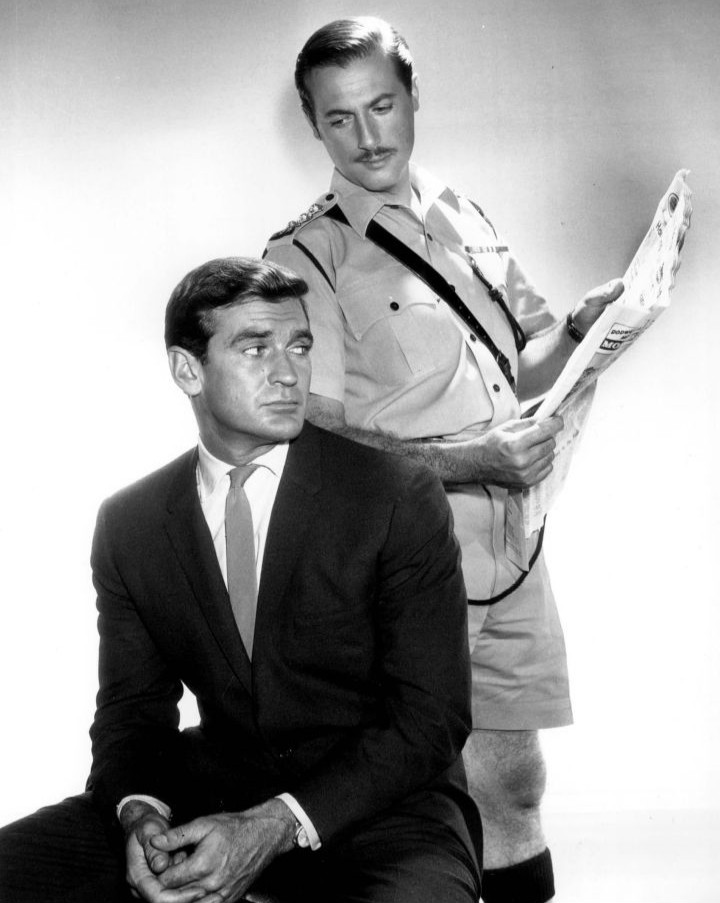
Hong Kong ran for only one season in 1960-61, but it was very well done. Rod Taylor was the star, playing a newspaper correspondent who for some reason is always getting into tight spots that somehow seem to involve a beautiful woman. His best friend is a police Chief Inspector, played by Lloyd Bochner. Many of the episodes are available on YouTube.
Friday, May 04, 2018
The difference between Elizabeth and Mary
Elizabeth's name is always associated with that of her younger and more attractive cousin and rival for the throne. Mary Stuart, the "Queen of Scots" who for years created complications for Elizabethan England. Queen of Scotland in her own name since babyhood, temporarily queen consort of France, and, as great-granddaughter of Henry VII, enjoying a title to the English throne almost as good as Elizabeth's, Mary was in a powerful position. Tall, with an exquisite pale skin and beautiful dark-brown eyes and hair, Mary had a feminine charm so irresistible that she is ranked as one of the most fascinating women of history. Passion and impulse, however, led her to throw away her many advantages and to be at times incredibly foolish. Her cold English cousin, with her masculine mind, sacrificed the woman to the queen; Mary sacrificed the queen to the woman every time. So it was that eventually Mary lost her life at Elizabeth's order.
(from A History of England and the British Empire)

(from A History of England and the British Empire)
Thursday, May 03, 2018
The Seahawks
Elizabeth also condoned, as we shall see, the raids of her seamen on the Spanish Main - a further example of how far a nation could go without actually declaring open war. Elizabethan England was full of men who were ready to fight papists or to chase galleons, with the clear understanding that if they should fail, Elizabeth and Cecil would disavow their acts to protesting ambassadors.
(From A History of England and the British Empire. The situation described here is what is depicted in the Errol Flynn movie The Seahawks.)

(From A History of England and the British Empire. The situation described here is what is depicted in the Errol Flynn movie The Seahawks.)
Wednesday, May 02, 2018
Michael Dunn - unusual detective
His was a familiar face on film and on television a couple of generations ago. Michael Dunn suffered from dwarfism and was only 3'11" tall. As he put it, he did not suffer from a lot of competition for his acting roles. According to the IMDB website, while he was waiting for his big acting break, one of the ways he supported himself was as a hotel detective, so he was not afraid to take on unusual occupations.

Tuesday, May 01, 2018
How state religions work
The Church of England was more than a matter of dogma and ritual. From one point of view it was a branch of the government. As an "established" church, its bishops were appointed and its policies were determined by the political authorities. Elizabeth herself, in order to spare the feelings of moderate Catholics, substituted, in enumerating her various titles, the expression "and so forth" where her father and brother had used "Supreme Head of the Church": but she retained full authority. Parliament even used its religious authority to decree that Wednesday, in addition to Friday, should be a meatless day, in order to encourage the fisheries.
(from A History of England and the British Empire)
(from A History of England and the British Empire)
Monday, April 30, 2018
Stagecoach
I watched the old movie Stagecoach this week, and I had forgotten what a well-done flick it was. It was, of course, the movie that made John Wayne's career. In the midst of an era of Saturday matinee B-grade westerns, it was a big-time show. Claire Trevor's performance as Dallas was classic, and Thomas Mitchell was Best Supporting Actor for his role as drunken Doc Boone. The tension during the race toward Lordsburg with Apaches in pursuit is great drama, and the final shoot-out with the Plummer boys is the appropriate finishing touch to a western. And, of course, there is romance of a different sort between Wayne and Trevor. Just a great movie.
Sunday, April 29, 2018
Economics even in the old days
Regular taxes could not meet the expenses; Somerset and Northumberland therefore carried to extremes the inflation of the currency started by Henry. Fortunately the possibilities of paper money were still unknown to the Western world. The worst they could do was to debase the currency to the lowest level in English history, ordering the mints to turn out shillings which were only one-quarter silver and three-quarters alloy. The great influx from the Spanish mines of Mexico and Peru was already beginning to lower the value of silver radically by increasing its supply, even without this deliberate inflation. The result was that prices jumped, and there was widespread distress.
(from A History of England and the British Empire)
(from A History of England and the British Empire)
Saturday, April 28, 2018
The ugly last days of Henry VIII
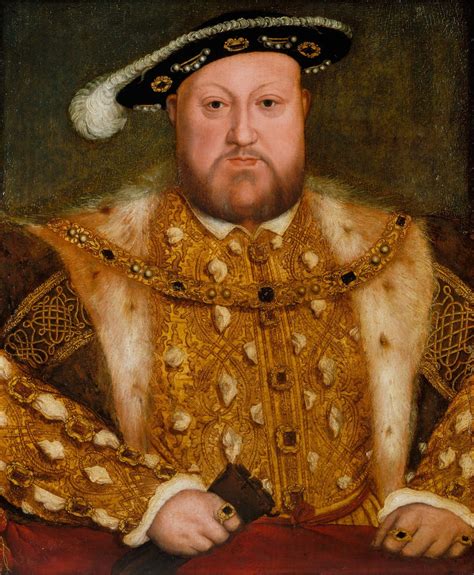
After Cromwell's execution Henry trusted no more in ministers but, in his own person - fat, coarse, diseased, and dangerous - headed a government more absolute than ever. Parliament had given away some of its own authority by permitting the king to make valid laws simply by proclamation, and it had given a dangerous extension to the scope of treason. It was unsafe to murmur even mild discontent against a ruler who did not hesitate to behead.
(from A History of England and the British Empire)
(from A History of England and the British Empire)
Thursday, April 26, 2018
She took her husband's name
Most old-time television fans are aware of the Ozzie and Harriet television program, and that the family was a real-life family. What they might not know is that Harriett Hilliard had put together a fairly good career in her own right well into the 1930s. However, with the beginning of their popular radio show in 1944, she became more familiarly known as Harriet Nelson. In Hollywood, it is a very rare thing for a wife who has an established film career to change her name to her husband's. I am not implying that in real life Harriet was as she was displayed in the show; the evidence is that she was somewhat more rough-cut than that. But at least she did take her husband's name.

Conquest by marriage
[Charles V's] vast heritage was the culmination of the marriage policy of the House of Hapsburg, whose diplomats were always on the lookout for eligible heiresses. A single marriage might determine the political destiny of a region for centuries, and it was by a constant succession of those marriages that the Hapsburg family built up its extensive but unnatural empire.
(from A History of England and the British Empire)
(from A History of England and the British Empire)
Wednesday, April 25, 2018
Exotic becomes commonplace
It is interesting how in each generation, young couples give names to their children that they perceive as being exotic and unusual. Then, as those names become popular, lots of people jump on the bandwagon and give those names to their children, and what was unusual becomes commonplace.
Tuesday, April 24, 2018
Loaded with bluebloods
Edward I, as we have seen, had helped to crystallize this practice of primogeniture and entail, whereby the family lands as well as the title went intact to the eldest son. The younger sons were commoners with no automatic social rank or privilege beyond what they might achieve for themselves, and were free to carry their inheritance of class - often their only heritage - into many diverse fields. It was through them in particular that the English social system came to possess more flexible features than the Continental. In France, and else where on the Continent, every son of a nobleman was a nobleman, also, rigidly limited by caste in the occupations which he might select. The class thus increased in geometric ratio, until in Poland, as an extreme case, it was estimated that there was a nobleman for every four acres of land.
(from A History of England and the British Empire)
(from A History of England and the British Empire)
Monday, April 23, 2018
Rapture of the deep
In the first season of the television show Sea Hunt, they introduced in multiple episodes the problem of a condition called "rapture of the deep," also known as nitrogen narcosis. Its noticeable effects are similar to drunkenness from alcohol or marijuana, and it particularly affects divers at deeper levels.

Sunday, April 22, 2018
How England avoided revolution
In France those sharp distinctions still continued; a man was a nobleman or he was not, and a vast gulf in prestige, privilege, and mode of life existed between social classes. The unprivileged paid most of the taxes and did all the work, but were not allowed to participate to any extent in the government. In England, on the other hand, the social frontiers were hazier, gradually blending all the way from dukes down to farm laborers. Those frontiers, too were easier to cross. There was, to be sure, a difference between "gentle" and "simple" folk; but class lines were not very sharply drawn. England was consequently more of a unit and was better able to escape the terrible revolt against the noble caste which was later to tear France apart.
(from A History of England and the British Empire)
(from A History of England and the British Empire)
Friday, April 20, 2018
Tate - just not a realistic premise
Tate was a television series that ran in 1960. The hero was a one-armed gunslinger who worked for hire (for the good guys, of course). He actually had his other arm, but had lost the use of it in the War of Yankee Aggression.
That a one-armed man could draw a gun is believable, but some of the other predicaments that he might get into on the frontier are not. Does it make much sense for him to go riding alone across the frontier, when the slightest accident could render him totally helpless? Things like putting on and buttoning his jeans became a major project with one hand. And the room for error in everyday matters would be so small in those days that the reality of a man being able to follow that line of work is practically nil.

That a one-armed man could draw a gun is believable, but some of the other predicaments that he might get into on the frontier are not. Does it make much sense for him to go riding alone across the frontier, when the slightest accident could render him totally helpless? Things like putting on and buttoning his jeans became a major project with one hand. And the room for error in everyday matters would be so small in those days that the reality of a man being able to follow that line of work is practically nil.
Thursday, April 19, 2018
The way to fight a war
The campaign of 1492 was glorified blackmail. Henry secured a very generous war grant from Parliament, and then, in the very week when Columbus reached America, crossed to France with some twenty-seven thousand men. He laid siege to Boulogne, not because he particularly wanted it, but because he knew that France was so busy in preparing to invade Italy that she would not want to be bothered with an English war. To the gratification of Henry and the disgust of his army, he was bought off before any serious bloodshed occurred. The royal treasury was consequently richer both by the expended balance of the Parliamentary grant and by the French bribe.
(from A History of England and the British Empire)
(from A History of England and the British Empire)
Wednesday, April 18, 2018
Watch out, tax collectors - the next guy may not like the IRS
The extortions caused bitter complaints. The name of [King Henry's] bishop-chancellor appeared in a tax-collecting device called "Morton's fork," by which, in the words of Francis Bacon, "the sparing were to be pressed for money because they saved, the lavish because they spent." The brunt of the odium fell upon Henry's two over-zealous and unscrupulous lawyers, Sir Richard Empson and Edmund Dudley, who continually dragged out the most flimsy pretexts to fine and confiscate in the king's interest. One of the first popular acts of Henry's son was to execute this hated pair.
(from A History of England and the British Empire)
(from A History of England and the British Empire)
Tuesday, April 17, 2018
Don't mess with the Hatfields
"I was in Kentucky once, a long time ago. The Hatfields have had three feuds. Somehow, there's always Hatfields left." (from A Man Called Trent, by Louis L'Amour)
I do not know about the claim of three feuds. Louis may have researched that, or it may be pure fiction. However, the Hatfields were downright mean, I know that. In this novel, however, they were on the side of the good guys.
I do not know about the claim of three feuds. Louis may have researched that, or it may be pure fiction. However, the Hatfields were downright mean, I know that. In this novel, however, they were on the side of the good guys.
Monday, April 16, 2018
Confidence was essential
Few of the real gunfighters doubted. To doubt would have been to fail. There was the famous case of the duel between Dave Tutt and Bill Hickock as an example. Hickock shot Tutt and turned to get the drop on Tutt's friends before the man shot had even hit the ground. Bill had known he was dead.
(from The Rider of Lost Creek, by Louis L'Amour)
(from The Rider of Lost Creek, by Louis L'Amour)
Thursday, April 12, 2018
It wasn't the gold
Spice stimulated the remarkable crop of early discoveries. Dreams of gold and glory may have played their part, but the great captains sailed primarily to secure cargoes of the pepper, ginger, cinnamon, and nutmegs which grew on rich islands just southeast of Asia. Europe demanded those spices in the days before refrigeration; for they were necessary to make meat palatable.
(from A History of England and the British Empire)
(from A History of England and the British Empire)
Wednesday, April 11, 2018
The doctor chose the heir?
The announcement that Lady Cholmondeley was expecting twins was revealed by Richard Kay of the Daily Mail[ and Mandrake of The Daily Telegraph. On 12 October 2009, the Marchioness gave birth to twin sons, Alexander Hugh George and Oliver Timothy George, who were originally expected in January. The birth took place shortly after Lady Cholmondeley was rushed to Queen Charlotte's Hospital in London, where she was monitored for two weeks. The elder son, Alexander, as heir apparent to the Marquessate, bears the courtesy title of Earl of Rocksavage; his brother is known as Lord Oliver Cholmondeley.
Assuming that the delivery was by caesarian section, then the difference between being known as The Marquess of Cholmondeley and merely Lord Oliver was a matter of minutes and purely at the discretion of the delivering doctor.
Tuesday, April 10, 2018

A strange quality of beauty
Some actresses are pretty, some are downright beautiful. Some, however, have a peculiar quality that I will term as "haunting," for lack of a better term. One such was France Nguyen. The interesting combination of names was due to the fact that her mother was French and her father Vietnamese.

A war? Ho, hum.
Throughout the long struggle [the War of the Roses] the bulk of the people were indifferent to its course. Not a single town was sufficiently interested in either side to withstand a siege, but to avoid trouble opened its gates to whatever force came along, as the easiest way.
(from A History of England and the British Empire]
(from A History of England and the British Empire]
Monday, April 09, 2018
Gory war
In most battles [in the War of the Roses] the heaviest casualties were suffered by the armored noblemen and mounted knights; for the footmen of the defeated army generally escaped slaughter by running away. Each side was inclined o follow victory with the execution of prominent prisoners. London Bridge was decorated with the severed heads of Lancastrian and Yorkist leaders in turn.
(from A History of England and the British Empire)
(from A History of England and the British Empire)
Sunday, April 08, 2018
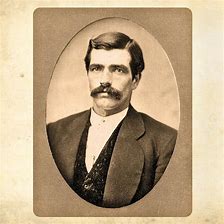
Tom Smith
Thomas "Bear River" Smith served as a lawman in New York City, Bear River, WY, and Kit Carson, CO, before becoming marshall of the rough and tumble cowboys of Abilene, KS in June 1870. He was mentioned by Louis L'Amour in his story "The Rider of Lost Creek."
Saturday, April 07, 2018
Supply and demand in the Middle Ages
So many serfs or villeins had died of the Black Death that crops lay ungathered, and fully a third of the arable land was left totally uncultivated. Naturally, the remaining workers appreciated the fact that their services were worth more than hitherto. They became more vocally discontented with the demands of the manorial system, and some refused to work at all on the old harsh terms. The owners of the manors, faced with danger of having vast fields lie untilled, and of the consequent loss of income, began gradually to alter the old manorial terms.
(from A History of England and the British Empire)
(from A History of England and the British Empire)
Friday, April 06, 2018
A neglected name
In this age of trendy names, one wonders why Heliotrope has been so neglected. After all, it is a beautiful color, so why not a beautiful name? Samantha Heliotrope Anderson, or something.

Jack Webb, a monument to bad acting
I might think Webb's terrible acting on Dragnet was on purpose, to try to make the role as everyday as possible, if it were not for his performances on radio shows. They were the same. He may have been an excellent producer and director, but he was not much at acting.

Thursday, April 05, 2018
What the Black Death left behind
"After the pestilence," writes another chronicler, "many buildings both great and small in all cities, towns, and boroughs fell into ruins for want of inhabitants, and in the same way many villages and hamlets were depopulated, and there were no houses left in them, all who had lived therein being dead; and it seemed likely that many such hamlets would never again be inhabited. In the following winter there was such a dearth of servants for all sorts of labor as it was believed had never been before. For the sheep and cattle strayed in all directions without herdsmen, and all things were left with none to care for them."
(from A History of England and the British Empire)
(from A History of England and the British Empire)
Wednesday, April 04, 2018
How bad was the Black Death?
When [King] Edward took his army across the Channel for the Crecy campaign in 1346, he left about four million subjects in England. Three years later scarcely two and a half million were left; the Black Death had done for the rest.
(from A History of England and the British Empire)

(from A History of England and the British Empire)
Tuesday, April 03, 2018
Nostalgia for country roads?
"Take me home, country roads," John Denver sang. It was a huge hit. And I must admit that I have a ton of pleasant memories associated with what is now Brewer Road on the northeast edge of Booneville, and others like it. We would go barefoot all summer, and it was a sign of your manhood that you could run on a dirt road barefooted. Sometimes when it was really hot, the dirt would become a skillet, and you could stand on it, so you would have to dash to the shade of a large tree.
On the other hand, dirt roads were dusty. Everything at a house along a dirt road was covered with a film of grit, and the houses were impossible to keep clean. Back in those days many cars did not have air conditioning, including ours, and so when we drove in the summer we had to have the windows down. If you passed another car, or if you followed a car at all closely, you had to eat dirt. So, the memories are definitely mixed in nature.

On the other hand, dirt roads were dusty. Everything at a house along a dirt road was covered with a film of grit, and the houses were impossible to keep clean. Back in those days many cars did not have air conditioning, including ours, and so when we drove in the summer we had to have the windows down. If you passed another car, or if you followed a car at all closely, you had to eat dirt. So, the memories are definitely mixed in nature.
Monday, April 02, 2018
Nice guy, but only to rich folks
This chivalry of the Black Prince and his fellows was reserved, like that of Richard the Lion-Hearted, entirely for the well-born. For the common people the prince showed a callous cruelty. For instance, upon hearing of the death of Sir John Chandos, his right-hand man, he assuaged his grief by storming Limoges and having two thousand men, women and children put to the sword without mercy. There was no Froissart to write the grim story of such forgotten men and women, who suffered murder, pillage and torture.
(from A History of England and the British Empire)
Sunday, April 01, 2018
Longbows
This longbow, the crossbow's rival, was of the primitive standard bow design, made of yew wood, about five feet high, and shot arrows a yard long. The English had been developing this for a long time as a distinctive weapon. Every village green had its archery practice, and by [the year] 1300 the sturdy yeomen were achieving remarkable speed nd accuracy with this new weapon. The longbow in skillful hands could be deadly at two hundred yards, could send off approximately six aimed shots a minute, and could shoot through a full inch of wood or a horseman's armor.
(from A History of England and the British Empire)
(from A History of England and the British Empire)
Subscribe to:
Posts (Atom)