
Saturday, March 17, 2018
No kin that I know of
No, folks, my own dear mother is no close kin to Irene Ryan (Granny Clampett), even though their physical stature is very similar.

Friday, March 16, 2018

Rule by oligarchy
"[William] the Conqueror had gathered the central power into his own hands, but even he needed ministers to conduct his government efficiently."
Except for the very smallest local situations in which a man can terrorize the population by his own physical force, every form of government is essentially an oligarchy. Since he cannot do everything by himself, the top man must have a small group of wealthy or powerful people who will support him. And, the ruler must have the support of the military leadership. In order to keep the military in line, he must have the support of a secret service or Gestapo or KGB. In free countries, the candidate must have the support of party leaders. So, in each form of government, it boils down to the rule of the few, or an oligarchy.
Except for the very smallest local situations in which a man can terrorize the population by his own physical force, every form of government is essentially an oligarchy. Since he cannot do everything by himself, the top man must have a small group of wealthy or powerful people who will support him. And, the ruler must have the support of the military leadership. In order to keep the military in line, he must have the support of a secret service or Gestapo or KGB. In free countries, the candidate must have the support of party leaders. So, in each form of government, it boils down to the rule of the few, or an oligarchy.
Thursday, March 15, 2018
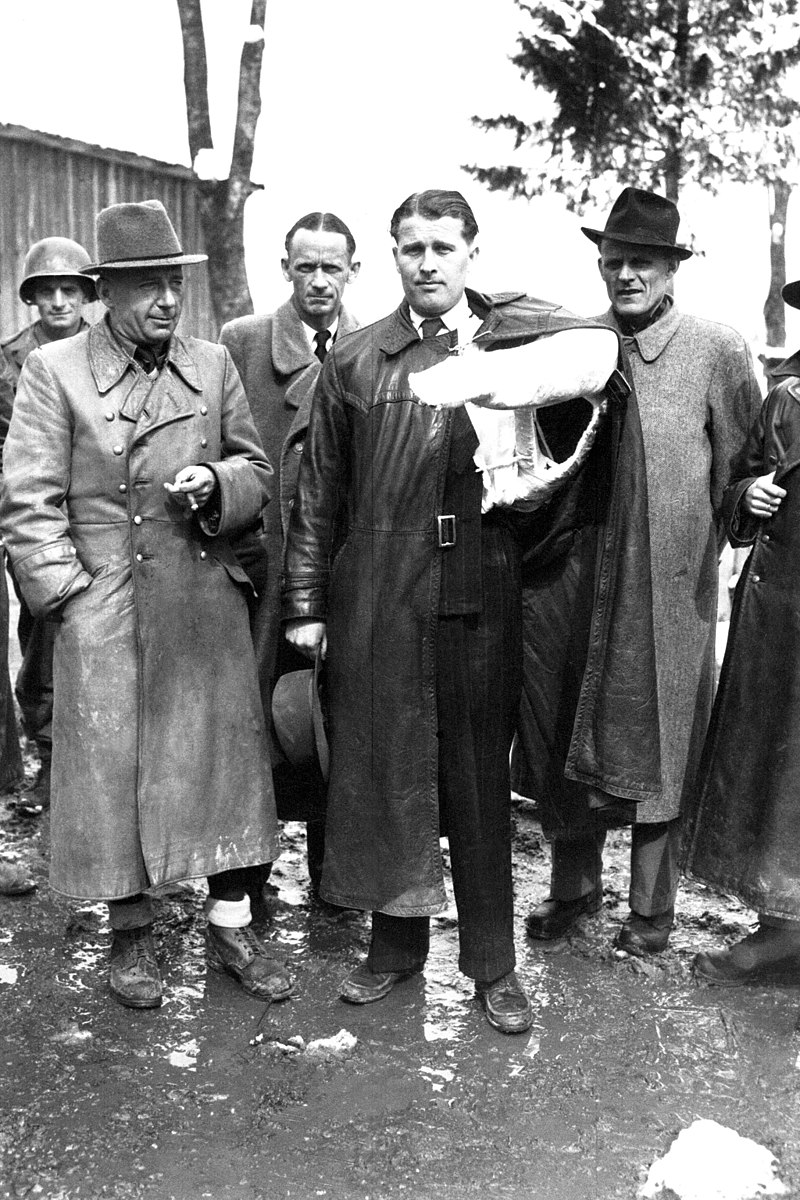
The amazing case of Wernher von Braun
To me, one of the most amazing decisions ever made by a United States official was the one that put former Nazi Wernher von Braun essentially in charge of the U. S. space program. The picture below is when he surrendered to the Americans.
Wednesday, March 14, 2018
Earnest T. Bass Day
Some of you will remember Earnest T., the hillbilly who had a few spots on the Andy Griffith Show. Well, according to Wikipedia:
"Ernest T. Bass' rock-throwing exploits are commemorated in the Natural Science sections of some museums and universities in the U.S. with 'Ernest T. Bass Day,' in which people who have stones they are unable to identify are encouraged to bring them in for inspection. This usually takes place on April 1, when Bass is believed to have celebrated his birthday on the show."

"Ernest T. Bass' rock-throwing exploits are commemorated in the Natural Science sections of some museums and universities in the U.S. with 'Ernest T. Bass Day,' in which people who have stones they are unable to identify are encouraged to bring them in for inspection. This usually takes place on April 1, when Bass is believed to have celebrated his birthday on the show."
Tuesday, March 13, 2018
How some English words originated
As Scott pointed out in Ivanhoe, the words for the common domestic animals - cow, calf, sheep, and pig - are Germanic, whereas the meat from those same animals - beef, veal, mutton, and pork - bears French names. The English tended the animals; but the choice roasts found their way to the high table of the [Norman] manor house.
(from A History of England and the British Empire)
(from A History of England and the British Empire)
Monday, March 12, 2018
Watch out!
"The forces of history are at work here," Tola Beg mumbled. "And that is something to avoid."
(from "May There Be a Road," by Louis L'Amour) When those large, history-altering events occur, generally speaking it is true that a lot of people get hurt one way or another.
(from "May There Be a Road," by Louis L'Amour) When those large, history-altering events occur, generally speaking it is true that a lot of people get hurt one way or another.
Sunday, March 11, 2018
Tri-lingual
For the next three centuries [after the Normans invaded], three different languages were heard in England. The churchmen, the scholars, and sometimes the lawyers used the international language, Latin. English remained the tongue of the bulk of the population; for we must remember that there were perhaps a million native English (Anglo-Saxons) and only a few thousand Normans. The new Norman French was the polite tongue of the royal court and of the dominant feudal minority.
(from A History of England and the British Empire)
(from A History of England and the British Empire)
Saturday, March 10, 2018
The hypocrisy of power
King William [the Conqueror] had been, and still continued to be, as bad a vassal to his liege lord, the king of France, as it was possible to imagine; but he had no intention of being so treated by any of his own vassals. . . . William, as duke of Normandy, held the allegiance of his vassals and let them "legally" against the French king; William as king of England saw to it that no vassal could do the same to him.
(from A History of England and the British Empire]
(from A History of England and the British Empire]
Friday, March 09, 2018
Thoughts On Speaking
Language should flow. As we express our thoughts, ideally the thoughts should not have to wait for the words (unless the subject matter is in some wise "touchy" and we must accordingly be especially careful of our words). Therefore, most people speak in their common language - the jargon of their peers. "How're ya gittin' along?" would be an example. We do not think about the precise manner of expression, as long as the words are sufficient to get across the thoughts we intend. In everyday affairs, the matters facing us are not ticklish enough that we must be overly picky about our speech.
HOWEVER, every man ought to know how to express himself precisely. Notice that I said "precisely," and not necessarily correctly. Grammar and syntax are fashion; they are not science. However, there are times when it does matter how things are said. "I told him he ought to get his car fixed yesterday." "I told him yesterday that he ought to get his car fixed." It makes a difference in the meaning where the "yesterday" is inserted, doesn't it? So, whether or not a man's language is elegant and fashionable, it needs to be accurate. Every man needs to know how to say what he intends to say, and the man who never gives thought to his speech will not know that.
God, in His infinite goodness, gave men the ability to express ourselves beautifully, as well as accurately. Anyone who has read the great speeches of Winston Churchill from 1940, or the poem, "She Walks In Beauty," by Lord Byron, has some idea of how language can be used with consummate skill to express beautifully the things that need to be said. It is good and necessary to be accurate in our speech; it is better also to be beautiful in our mode of expression - at least from time to time. Anyone who uses the King James Version of the Bible ought to have an appreciation for the fact that it is important how things are said, and not only what is said. The ultimate goal of language is that it be true, and also be lovely.
HOWEVER, every man ought to know how to express himself precisely. Notice that I said "precisely," and not necessarily correctly. Grammar and syntax are fashion; they are not science. However, there are times when it does matter how things are said. "I told him he ought to get his car fixed yesterday." "I told him yesterday that he ought to get his car fixed." It makes a difference in the meaning where the "yesterday" is inserted, doesn't it? So, whether or not a man's language is elegant and fashionable, it needs to be accurate. Every man needs to know how to say what he intends to say, and the man who never gives thought to his speech will not know that.
God, in His infinite goodness, gave men the ability to express ourselves beautifully, as well as accurately. Anyone who has read the great speeches of Winston Churchill from 1940, or the poem, "She Walks In Beauty," by Lord Byron, has some idea of how language can be used with consummate skill to express beautifully the things that need to be said. It is good and necessary to be accurate in our speech; it is better also to be beautiful in our mode of expression - at least from time to time. Anyone who uses the King James Version of the Bible ought to have an appreciation for the fact that it is important how things are said, and not only what is said. The ultimate goal of language is that it be true, and also be lovely.
How William paid his help
In England, William had a unique opportunity to wipe the slate clean and to modify the Norman-French feudal system to his own liking. It was almost inevitable that he should continue the system, for he and his followers had known no other. Furthermore, the only thing he possessed wherewith to reward his avaricious men was land; and he needed from them the feudal return of military service, to garrison the conquered country. Consequently, he claimed that the Conquest gave him title to the estates of all Anglo-Saxons.
(from A History of England and the British People. Shades of Robin Hood, huh? No wonder the Saxons hated the Normans!)
(from A History of England and the British People. Shades of Robin Hood, huh? No wonder the Saxons hated the Normans!)
Thursday, March 08, 2018
How the feudal system worked
Under the political feudal system all of the land of a country belonged in theory to the ruler. He always retained a portion of it as a demesne (royal domain, or crown lands), to provide himself with his direct private revenue, while the remainder was divided among his more important followers for military reasons. These retainers, in turn, likewise kept a demesne for themselves, and, if their portion was large enough, parceled out the rest to retainers of their own. This process generally continued down through at least three or four stages, until the pieces of land became so small that they could serve only as a demesne without further subdivision. The land thus transferred was known as a fief, which in Latin is feudum (hence, "feudal" system).
(from A History of England and the British Empire)
(from A History of England and the British Empire)
Wednesday, March 07, 2018
Origins of the English feudal system
The most revolutionary of all the Norman changes was the transplanting to England of that system of "land tenure based on military servitude" which had gradually grown up in Europe during the two centuries following the break-up of Charlemagne's empire - the so-called feudal system. Under it the ablest fighters received estates from the king and higher nobles in return for military service. In the chaotic days which followed the barbarian invasions in Europe, the rulers lacked money but had plenty of land. The only way for a noble to become wealthy and powerful was to secure a vast acreage; for, in the absence of modern industrial and financial capital, land was almost the only source of wealth.
(from A History of England and the British Empire)
(from A History of England and the British Empire)
Tuesday, March 06, 2018
William's innovations
"William made only three new laws, the most striking dealing with his reservations of vast forests for the royal hunt, for 'he loved the tall stags as if he were their father.'"
This is from A History of England and the British Empire. It is speaking of the policies instituted by William the Conqueror when he took over as King of England. This is significant in Hollywood history, because you will remember the early scene in Robin Hood when Much the Miller is about to be punished by the Sheriff of Nottingham, but Robin rescues him. It turns out that that actually is referring to a major part of law enforcement by the Normans.

This is from A History of England and the British Empire. It is speaking of the policies instituted by William the Conqueror when he took over as King of England. This is significant in Hollywood history, because you will remember the early scene in Robin Hood when Much the Miller is about to be punished by the Sheriff of Nottingham, but Robin rescues him. It turns out that that actually is referring to a major part of law enforcement by the Normans.
Monday, March 05, 2018
Whiplash TV series
This series, filmed in 1959-60, was based on the life of Freeman Cobb, the founder of Australia's first stagecoach line. It used only Australians as guest stars, rather than character actors. Featured prominently in the series were the aboriginal people of Australia. The star was Peter Graves, who later went on to fame as the star of Mission: Impossible.

Sunday, March 04, 2018
They had the Green Hornet in the Middle Ages?
Some of William the Conqueror's "most oppressive acts were within the bounds of legal technicality; for although he respected law he made it his slave." The Green Hornet's great task was dealing with "criminals within the law," that is, those whom the police could not couch due to those same legal technicalities. Do you suppose, even back then . . . . .?
Saturday, March 03, 2018
Some differences in the old Anglo-Saxon legal code
In two particular features he law differed from the present. The wergild, for homicide, was determined without regard to those considerations of motive which now result in varying penalties for first-degree and second-degree murder, manslaughter, and justifiable homicide. Then, too, it was necessary for the injured party to hale the offender into court, to prosecute the case, and to collect the fine.
(from A History of England and the British Empire)
(from A History of England and the British Empire)
Friday, March 02, 2018
The stress of commerce
I fine the work a little trying. There is too much ledger-lugging to be done for my simple tastes. I have been hauling ledgers from the safe all the morning. The cry is beginning to go round, "Psmith is willing, but can his physique stand the strain?" In the excitement of the moment just now I dropped a somewhat massive tome on to Comrade Gregory's foot, unfortunately, I understand, the foot in which he has of late been suffering twinges of gout. I passed the thing off with ready tact, but I cannot deny that there was a certain temporary coolness, which, indeed, is not yet past. These things, Comrade Jackson, are the whirlpools in the quiet stream of commercial life.
(from Psmith in the City, by Sir Pelham Wodehouse)
(from Psmith in the City, by Sir Pelham Wodehouse)
Thursday, March 01, 2018
Less than dignified
Mr. Bickersdyke was reclining in an easy-chair in the first room, staring before him in the boiled-fish manner customary in a Turkish Bath. Psmith dropped into the next seat with a cherry, "Good evening." The manager started as if some firm hand had driven a bradawl into him. He looked at Psmith with what was intended to be a dignified stare. But dignity is hard to achieve in a couple of parti-coloured towels. The stare did not differ two any great extent from the conventional boiled-fish look, alluded to above.
(from Psmith in the City, by Sir Pelham Wodehouse)
(from Psmith in the City, by Sir Pelham Wodehouse)
Subscribe to:
Posts (Atom)